
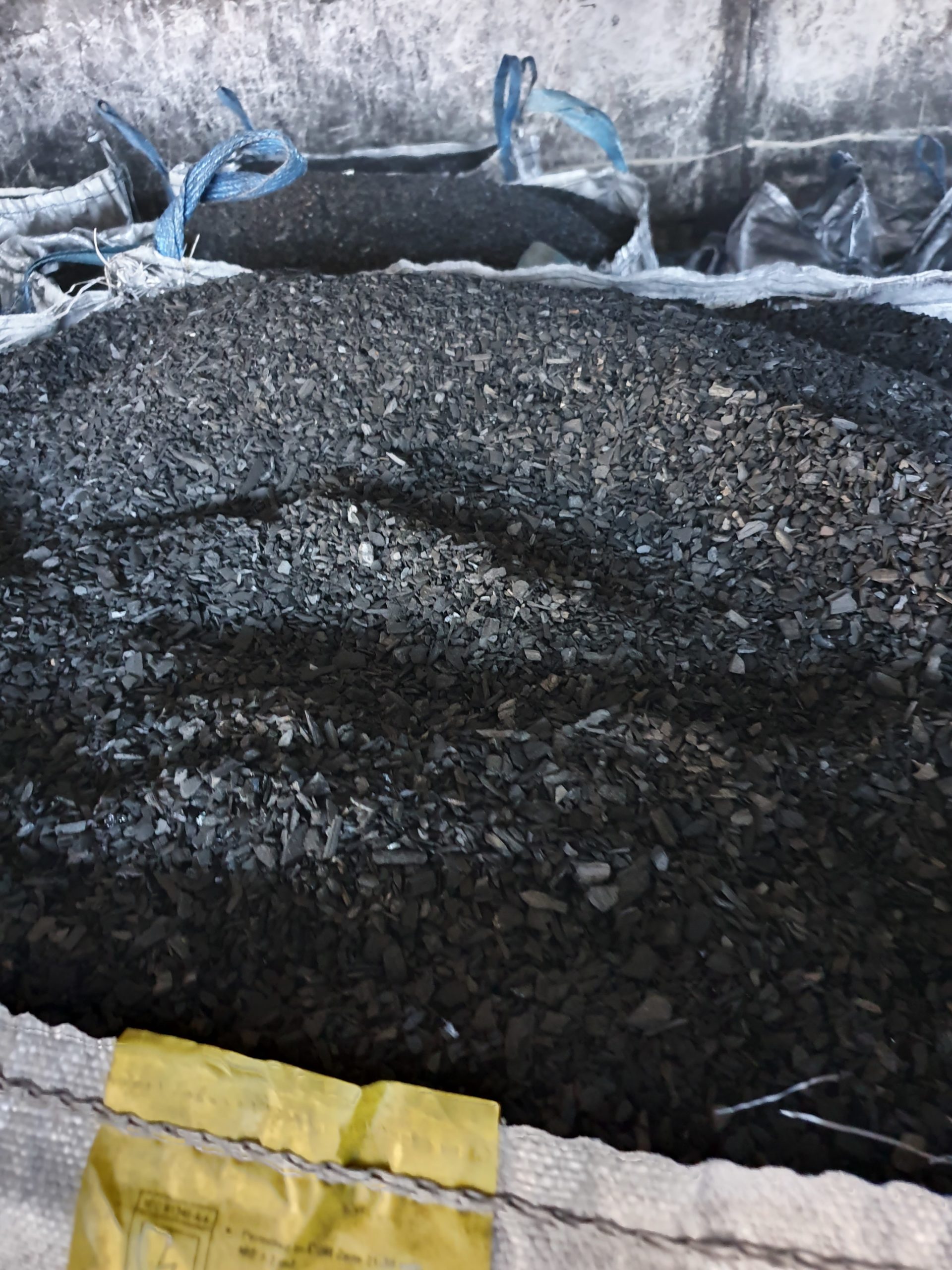
If you’ve read the SoilFixer backstory, you’ll know that Tony’s journey into biochar started unusually early. Long before “carbon removal” and “negative-emissions technologies” became mainstream talking points, Tony was hands-on, trying to understand what made some soils come alive — and how stable carbon could be engineered into that process.
His entry point came in 2011, through the earliest days of SoilFixer. At the time, almost nobody in the UK was talking about biochar outside of academic circles. The first practical opportunity came when Tony joined a small, determined team who ran what was probably the first Kon-Tiki kiln in the UK. What later became known as “artisanal biochar” was, back then, simply a group of curious people working out how to clean-burn woody material to create a stable, high-surface-area carbon that behaved in soil in extraordinary ways.
Those early runs were crude, smoky, experimental — but they revealed something powerful: if you could combine feedstock, fire behaviour, ash chemistry and quenching at the right moments, the resulting char had properties that genuinely boosted soil function. But to have any meaningful climate or soil impact, it wasn’t enough to make a few kilograms at a time. It had to scale — massively.
Scope note
This article describes historical development, design intent, and market context.
It does not define material eligibility, biological performance, or guaranteed outcomes.
Technical behaviour, biological function, and reuse conditions for biochar in soil or filtration are defined separately within the HealthySoil Canonical framework and the Biochar Filters technical pillars.
And that was the next challenge.
Scaling biochar: much harder than it looks
Over the following years Tony became involved in a sequence of pilot and prototype scale-up projects. Some succeeded partially, many failed completely, and all taught important lessons.
Scaling biochar is not trivial. It sits at the intersection of:
- Pyrolysis engineering — controlling temperatures, gases, throughput and safety
- Feedstock sourcing — finding consistent, local material at viable cost
- End-use markets — from soil to filtration to composites
- Financing and infrastructure — because nobody builds a commercial-scale pyrolysis plant for fun
Tony’s breakthrough came through support from Crapper & Sons, now known as Sustain Wiltshire, who offered space and operational support to continue development work. Access to a real waste-processing environment allowed far deeper experimentation: different feedstocks, different quench and post-processing techniques, and the early investigations into “biochar-humus composites” that later became foundational SoilFixer IP.
But even with a location, it still needed the right technology. Several pilots demonstrated the same pattern: small-scale simplicity did not translate into large-scale stability. Through constant searching, Tony eventually connected to Woodtek — UK manufacturers of a genuinely robust, well-engineered pyrolysis system designed for consistent, repeatable char production. This was a major step. At last, the technology existed that could scale properly if the surrounding business model and feedstock chain were strong enough.
A new partnership with scale vision
Around this time, a sustainability-focused company — A Healthier Earth (AHE) — emerged with a strong interest in circular carbon, energy, and biochar as an offset technology. Through conversations with Tony, a shared opportunity became obvious.
Sustain is running a PAS100 composting site producing significant volumes of woody oversize — exactly the kind of lignocellulosic fraction that can be upgraded into high-quality biochar.
Tony became the link between AHE and Crapper/Sustain and Woodtek, creating the alignment needed for something far bigger:
a fully integrated, UK-scale biochar production project leveraging waste-wood oversize, proven pyrolysis technology, and a reliable future market.
This tri-party alignment is now progressing (although Pyreg is now the technology partner) to build what will be the UK’s largest dedicated biochar production facility — a milestone that could finally bring biochar out of “interesting niche” territory and into genuine climate relevance.
Beyond soil: finding the real market pull
While SoilFixer continued to focus on soil health, Tony started researching wider, higher-value applications for biochar. Not every end-use makes sense commercially. Some require properties that only activated carbon can achieve; others rely on regulatory frameworks that move slowly.
But one area stood out clearly: biochar-based filtration.
Activated carbon has been used for decades in gas purification, wastewater treatment, and environmental remediation. The technology is mature — but the feedstock is often fossil-derived or imported, with high energy intensity. A global shift is now underway toward more sustainable, lower-carbon filtration media.
Biochar is not a drop-in replacement for activated carbon — it behaves differently, has different porosity, and relies more heavily on microbial consortia, aeration, and biofilm dynamics. This is where Tony’s background becomes a genuine differentiator: his deep understanding of compost aeration, microbial pathways, and humus formation transfers directly into the design of biochar filter media that work biologically, not just chemically.
Today, Tony is focusing on specific, high-value segments where biochar can outperform traditional materials:
- Odour and ammonia control
- Aerobic wastewater polishing
- Leachate stabilisation
- Agricultural runoff and nutrient capture
- Microbe-enhanced biological filtration systems
These are areas where surface chemistry alone is not enough — you need aeration, microbial colonisation, and stable carbon scaffolds. This aligns directly with SoilFixer’s heritage and Tony’s long technical journey.
Where is this going next?
The convergence of:
- secure feedstock
- proven UK pyrolysis technology
- a large-scale production site
- and the emerging market demand for sustainable filtration media
…creates something the UK has not had before: the possibility of a commercially viable, climate-relevant, long-term biochar industry.
Not artisanal. Not experimental. Commercial. Scalable. Permanent.
Tony’s role continues to be what it has always been — connecting dots between soil science, carbon materials, practical engineering, and business models that work. The next decade of this story will be about applying biochar not just to soil, but to water, air, waste streams, and integrated biological systems in ways that are scalable and genuinely impactful.
Link references: