
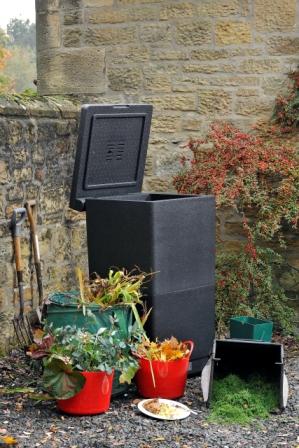
People often assume the HOTBIN arrived fully formed — a neat, insulated box that magically turned kitchen scraps into compost in just a few weeks. In reality, its origins lie in frustration, failed experiments, a few stinky disasters, a rat, and one very thick book.
Corporate job, family life

Back in the late 2000s, Tony Callaghan was working for a large corporate (Sage plc), had a young family and house with garden. Like many keen gardeners, he was trying to make home composting work properly. His local council had issued the standard black “dalek” compost bin, and very quickly it began to overflow. Grass cuttings piled up, veg peelings lingered stubbornly, and the heap resolutely refused to heat up. The bin was never truly hot, never truly composting in any meaningful timeframe.
Thinking the solution was simply “more space,” Tony built a second pallet-wood bin. It looked promising — rustic, ventilated, and twice the size. Yet the outcome was exactly the same: slow, cold composting, months of waiting, and piles of unmoved material. The final straw came one afternoon when Tony spotted a rat in the bin, happily removing a piece of discarded carrot. That was the moment he realised that traditional home composting wasn’t just slow — it was flawed.
So he set himself a challenge: understand how to compost faster and properly.
Composting science
At first, Tony did what everyone did back then — he googled and read the usual gardening blogs and how-to guides on “hot composting.” Most promised miraculous heat levels and fast breakdown simply by layering materials in the right ratio. He followed all the advice faithfully. And… very little changed. The heaps still slumped into cold, wet, slow composting. Something wasn’t adding up.
Recognising that the answer wasn’t on popular gardening websites, Tony went deeper. He began experimenting with insulated wheelie bins, trying to retain heat and encourage more active decomposition. Some prototypes did warm up, but many more turned into slimy, anaerobic disasters. At one point he opened a bin to find what he describes only as a “stinky, swamp-like, anaerobic mess that made the family suspicious.”
It became clear that practical home composting advice and professional compost engineering were worlds apart.
Determined to understand the science properly, Tony bought one of the most authoritative technical texts available: The Composting Handbook by Haug — a weighty, engineer’s reference manual. As he worked through the dense chapters, things clicked. Much of the common composting advice circulating online was either incomplete, out of context, or sometimes just plain wrong. Real hot composting required more than balancing “greens and browns.” It required thermal insulation, controlled buoyant airflow, proper moisture management, and a design that maintained biological heat inside the pile rather than letting it leak into the air.
Armed with this new knowledge, Tony refined his insulated-bin experiments. Slowly, prototypes started to behave the way Haug’s equations predicted. They heated rapidly, stayed hot without constant turning, and broke material down far faster than the open or council-supplied bins.
But understanding the science and designing a product were two very different things.
The “lightbulb” moment
This was around 2010. WRAP — the UK Government’s Waste & Resources Action Programme — was heavily promoting home composting, especially food-waste composting. Tony realised that if he could create a reliable, insulated, user-friendly hot composter that genuinely worked, he could help households divert significant amounts of food waste from landfill.
At the same time, Tony’s employer, Sage Plc, opened a voluntary redundancy programme. It was a moment of opportunity. He applied for early backing through NorthStar Ventures and made the leap — leaving corporate life to develop what would become the HOTBIN.
Manufacturing a new product
What followed were months of prototyping and setbacks. The science worked; manufacturing it at scale did not. Materials warped, lids cracked, costs ballooned. Tony struggled to find a manufacturing method that could produce a robust, fully insulated bin without making it impossibly expensive.
Eventually, he made contact with Engineered Foam Products Ltd (EFP), specialists in moulded expanded polypropylene (EPP). Their R&D manager at the time, Andrew Wilders, understood what Tony was trying to achieve. Within a week, Andrew’s team produced a professionally moulded prototype — insulated, strong, clean-lined, and manufacturable. The costings were workable. For the first time, the HOTBIN looked like a real product, not a shed experiment.
A few months later, in 2011, HOTBINcomposting.com went live, and the first HOTBINs were sold.

The product resonated immediately. People who had struggled for years with cold bins finally had something that worked: a compact, insulated system that could digest garden waste and food scraps quickly, cleanly, and without pests. Reviews spread, early adopters championed it, and retailers began to take interest.
Exit and future
Three years later, EFP acquired the patent and website from Tony, allowing for larger-scale investment and manufacturing. Under their stewardship, HOTBIN grew into the UK’s leading hot composting system, winning multiple product awards and becoming a household name in sustainable living.
Today, more than fifteen years after the first prototype, Tony still works with EFP in a design-stewardship role — providing new concepts, technical guidance, and long-term vision. That collaboration has already produced innovations like the HOTBIN Mega (400- and 600-litre units), with more on the horizon.
The HOTBIN story is ultimately one of persistence: from overflowing council daleks and rat-raided heaps, to engineering textbooks, failed experiments, and a chance redundancy opportunity. It’s also a reminder that meaningful change often starts with a simple question:
“Why doesn’t this work — and how can I make it better?”
Tony asked that question. The HOTBIN is the answer
References:
Roger T. Haug, The Practical Handbook of Compost Engineering. Publisher: Lewis